
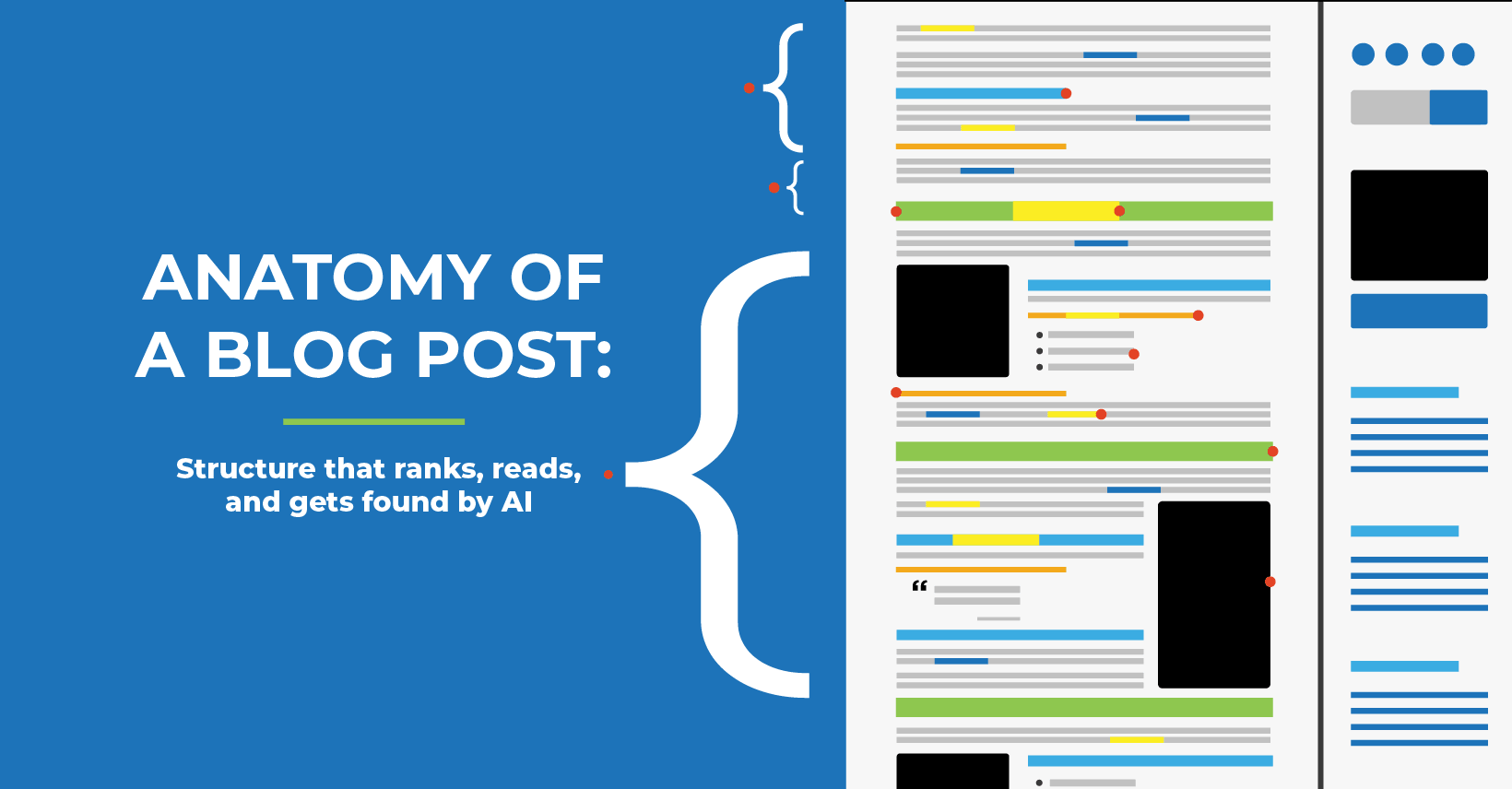
The Anatomy of a Blog Post: Structure That Ranks, Reads, and Gets Found by AI

Most contractor blogs fail before the first person reads them. Not because the writing is bad. Not because the topic is wrong. Because the structure is broken.
Google doesn’t just rank content — it ranks content it can understand. AI tools like ChatGPT, Perplexity, and Google’s AI overviews pull answers from posts that are organized clearly enough to extract. A blog with no structure is invisible to both.
I’ve been writing and ranking blogs for over 15 years — for my own businesses and for hundreds of contractors across the country. What I’ve learned is this: well-written content with poor structure loses to average content with great structure, every single time.
This post breaks down the anatomy of a blog post — every section, in order — so you know exactly what goes where, why it matters, and how to format your content for the way search actually works right now. Whether you’re writing your own posts or reviewing what an agency is handing you, this is the structure that holds up.
Skip this, and you’re creating content that works against you — burning time and budget on posts that don’t rank, don’t convert, and don’t get surfaced by the AI tools your customers are increasingly using to find contractors.
Why Blog Structure Matters More Than Ever
Search has changed. A few years ago, keyword density and word count were enough to push a page up the rankings. That era is over.
Three things are true right now that weren’t five years ago:
- Google’s E-E-A-T framework — Experience, Expertise, Authoritativeness, and Trustworthiness — rewards content that is clearly organized, specific, and easy to evaluate. Thin, generic posts get filtered out.
- AI overviews in Google search pull directly from well-structured posts. If your headings are vague and your answers are buried in paragraphs, you’re not getting cited. If your structure is clean and your answers are clear, you are.
- AI tools like ChatGPT and Perplexity are becoming how people find contractors — especially for research and comparison queries. Your blog is now training data. Structure determines whether that works for you or against you.
A well-structured post doesn’t just rank better. It gets pulled into AI answers, keeps readers on the page longer, and builds the kind of trust that makes a contractor look like the obvious choice before anyone picks up the phone.
The 3-Part Framework Every Blog Post Needs
Before getting into the individual elements, here’s the philosophy I build every post around. It’s simple. Most people don’t follow it.
A blog post has exactly three jobs:
1. Make a Promise
The introduction tells the reader what they’ll learn, what problem it solves, and — critically — what’s at risk if they stop reading. If you can’t make that case in the first few sentences, they won’t stick around.
The promise isn’t a teaser. It’s a contract. You’re telling the reader exactly what they’re going to walk away with. And whatever you promise in the intro, the body has to deliver — completely and in that order.
2. Keep the Promise
Your body delivers exactly what the introduction promised. Nothing more, nothing drifts. If your intro says ‘five reasons your contractor blog isn’t generating leads,’ your body has five sections — each one a reason. No tangents, no extra topics that seemed relevant, no stuffed-in content.
The moment the body drifts away from the original promise, the reader feels it — even if they can’t name it. They stop trusting the content. They stop reading. And Google’s engagement signals notice.
3. Close the Loop
The conclusion summarizes what was covered, reinforces the key takeaway, and points the reader toward a clear next step. Not a hard sell. Not a pivot to a different topic. A logical next action that flows directly from what they just read.
That’s the framework. Everything below is execution.
The Full Anatomy, Section by Section
Here’s how every element of a blog post fits together — and what each one needs to do.
SEO Title (50-60 Characters)
This is what appears in Google search results and browser tabs. It’s separate from your blog’s visible H1 title, though they’re often similar. Your SEO title must include your primary keyword and be written to earn a click — not just rank.
Keep it under 60 characters. Google truncates anything longer, cutting off the part readers need to decide whether to click.
Meta Description (145-155 Characters)
The one or two sentences that appear below your title in search results. They don’t directly affect rankings, but they directly affect whether someone clicks. Include your primary keyword within the first 100 characters. Lead with what the reader gets — not just what the post covers.
URL Slug
Your URL should contain your primary keyword and nothing else. Lowercase, hyphenated, no dates, no filler words. A clean URL is easier for Google to parse and easier for readers to share or remember.
Good: /how-to-get-more-painting-leads
Bad: /blog-post-how-to-get-more-leads-for-your-painting-company-2024
H1 — The Blog Title
WordPress automatically tags your post title as H1. Don’t apply it manually — you’ll end up with two H1s, which creates a structural error. Your title should include your primary keyword verbatim and clearly reflect what the post covers. No clickbait. No vague promises.
The Introduction (160-200 Words)
This is where most blogs lose their readers. A weak intro creates high bounce rates, low time-on-page, and a clear signal to Google that your content isn’t delivering.
A strong intro does three things:
- Hooks the reader with a problem, a sharp observation, or a direct challenge
- States exactly what they’ll learn by reading
- Makes clear what’s at risk if they skip it
Your primary keyword should appear naturally in the first paragraph — once. Don’t force it in twice to hit some keyword density target. One clean, natural use is the standard.
H2 Body Sections
Each H2 is a chapter. It covers one distinct idea, delivers on what its heading promises, and moves the reader forward through the customer journey one step at a time.
Rules for strong H2 sections:
- The heading alone should tell the reader what this section covers — no ambiguity
- Each section earns its place. If removing it doesn’t weaken the post, cut it
- Paragraphs stay at 1-2 sentences. No walls of text
- Lists and bullets where they improve scannability — not just to break things up
- No section repeats what another section already covered
Read only your headings, top to bottom. If a reader can understand the post’s structure and value from the headings alone, you’ve passed the skim test. If the headings are vague or repetitive, restructure before you write a word of body copy.
H3 subheadings can be used within a section when a topic has multiple distinct components — but use them sparingly. If you’re nesting H3s under every H2, you probably need to split the post or simplify the structure.
The Conclusion + CTA (200-240 Words Combined)
The conclusion summarizes the key points and closes the loop on what the intro promised. No new ideas. No pivots. Just a clear, confident wrap-up of what was covered.
The call to action follows directly — integrated into the conclusion, not labeled ‘Call to Action.’ It should feel like a natural extension of what the reader just learned. Point them toward a logical next step that fits where they are in the journey.
For contractors reading SCG content, that might be joining the Local Growth Academy, reading a related post, or booking a call. The transition should feel earned, not bolted on.
Writing for AI Readability
This section didn’t exist in the original version of this post. It does now because the landscape changed.
Google’s AI overviews, ChatGPT, Perplexity, and similar tools are increasingly the first stop for contractor-related research. When someone asks an AI ‘how do I get more roofing leads’ or ‘what should a contractor blog post include,’ it will pull an answer from somewhere. The question is whether that somewhere is your content or your competitor’s.
Here’s what AI systems actually look for when deciding what to surface:
Direct Answers Near the Top of Each Section
Don’t bury your point. Lead with the answer, then support it with context. AI doesn’t want to read three paragraphs to find your conclusion. Neither does your reader.
Headings That Mirror How People Search
Your H2s function as answers to implied questions. ‘Why does blog structure matter?’ and ‘How do I write a blog introduction?’ are both strong headings and likely AI queries. When your headings match the way people phrase real questions, you’re structuring your content to get cited.
Short Paragraphs, Clean Formatting
AI systems extract content at the sentence and paragraph level. Dense blocks of text are harder to parse and less likely to be surfaced as a clean answer. Keep paragraphs short. Use lists where it makes sense. Format for humans — AI will follow.
Authoritative, Specific Language
Vague claims and over-hedged statements reduce the likelihood that AI will use your content as a source. Specificity signals authority. ‘A strong blog introduction is 160-200 words and includes a hook, a promise, and a stated risk’ is far more citable than ‘introductions should grab the reader’s attention.’
One Clear Idea Per Section
Don’t cover multiple ideas under a single heading. One heading, one idea, one clear answer. This is true for human readability and essential for AI extraction.
Quick Note on AI and SEO None of this is about gaming AI. It’s about writing clearly. The same structure that makes content easy for humans to read makes it easy for AI to understand, extract, and cite. The standards are the same — good structure just matters more now because the audience has expanded to include machines that are actively pulling answers from your content.
Structure Is the Strategy
Blog structure isn’t a formatting preference. It’s the difference between content that compounds over time and content that sits unread.
Every element in this breakdown — SEO title, meta description, URL slug, H1, introduction, H2 body sections, conclusion, and CTA — has a specific job. When they work together, Google understands the post, AI systems can reference it, and readers stay engaged long enough to act.
The three-part framework is worth keeping front of mind on every post you write or review: make a promise in the intro, keep it in the body, close the loop in the conclusion. If a post fails that test, no amount of keyword optimization fixes it.
For contractors, this is one of the most durable marketing investments you can make. A well-structured blog keeps working long after it’s published — unlike paid ads, which stop the moment your contractor marketing budget does. It doesn’t turn off when the ad budget does. The blog doesn’t disappear when a platform changes its algorithm. It compounds.
If you want to go deeper on how to build a content system that actually compounds — from choosing the right topics to structuring posts like this one to getting them found consistently — that’s exactly what we help contractors do inside our coaching program. If you’re ready to stop guessing and start building content that works, learn more about working with SCG.