
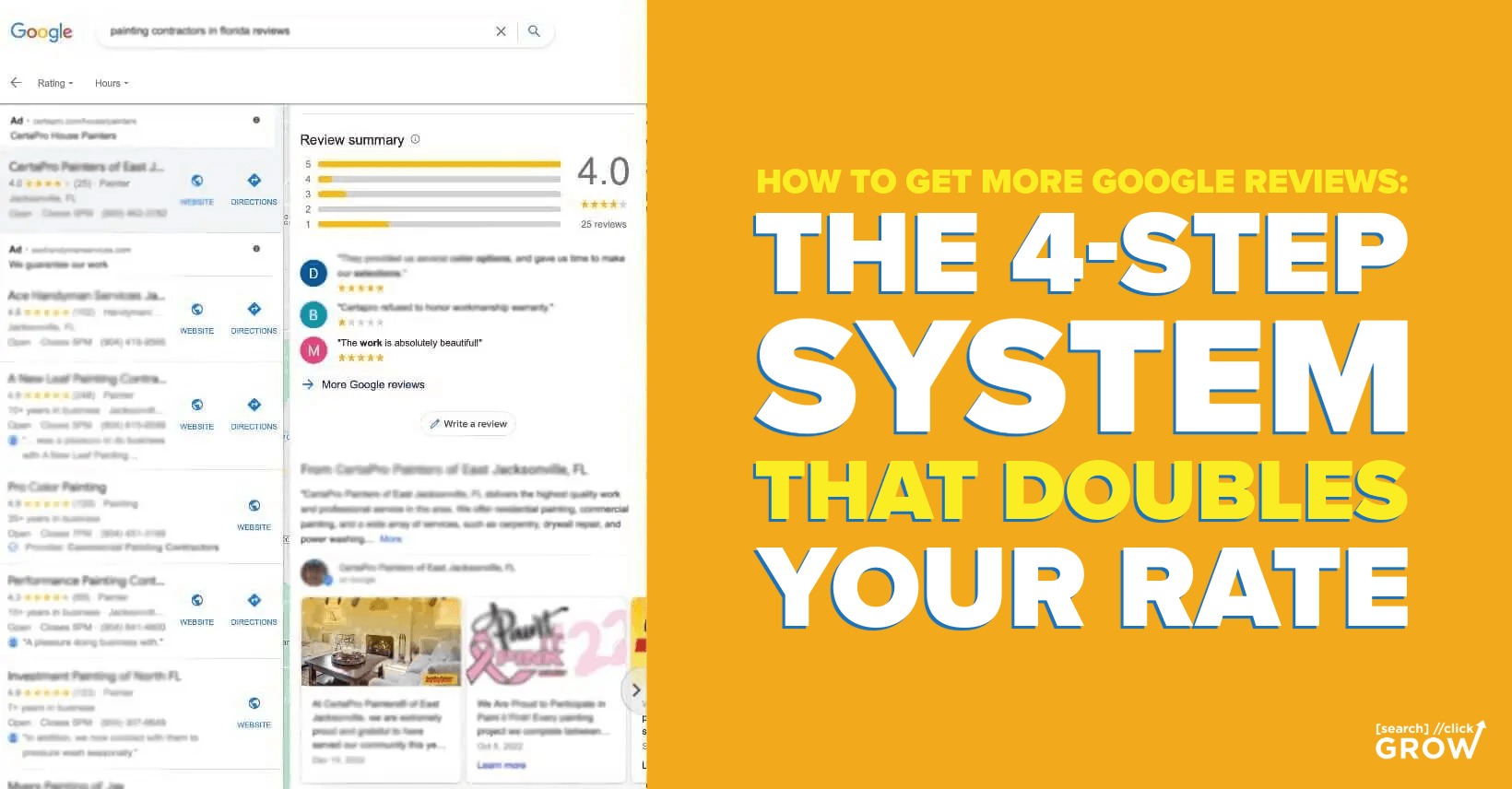
How to Get More Google Reviews: The 4-Step System That Doubles Your Rate

Most contractors have the same review strategy: send a link after the job is done and hope for the best. That approach gets a 10 to 15 percent conversion rate at best — meaning for every ten completed projects, you’re walking away with one or two reviews.
There’s a better way, and it starts well before the job ends.
I’ve worked with hundreds of home service contractors across the US and Canada, and the ones generating a steady stream of high-quality Google reviews aren’t doing anything complicated. They’re doing something intentional — a simple four-step process that plants the seed early, reinforces it during the job, and asks at exactly the right moment.
This post covers why Google reviews matter more than most contractors realize, why the standard approach underperforms, and the specific system we teach that consistently outperforms the send-a-link-and-wait method.
If you’re relying on a CRM email blast to build your review count, this will change how you think about it.
Why Google Reviews Are One of Your Highest-Leverage Assets
For contractors, Google reviews do four jobs simultaneously — and most people only think about one of them.
1. They Influence Where You Show Up in Local Search
Review count and review quality are both direct ranking factors in Google’s local algorithm. More reviews, more recent reviews, and higher average ratings all contribute to where your business appears in the local map pack — the three listings that show up above organic results for searches like “painters near me” or “flooring contractor Jacksonville.”
If your competitors have more reviews than you, they have an advantage in the map pack that no amount of website SEO alone can fully overcome.
2. They Convert Searchers Into Calls
Getting found is only half the battle. When a homeowner sees three contractors in the map pack, reviews are the primary factor in who they call first. A contractor with 85 reviews at 4.9 stars will get more calls than a competitor with 12 reviews at 4.7 — even if both businesses do equally good work.
The number tells them you’re established. The rating tells them you’re reliable. The content of the reviews tells them what to expect. All three matter.
3. They Signal Trust to Google’s AI Tools
Google’s AI overviews and tools like ChatGPT are increasingly pulling contractor recommendations from Google Business Profile data — including reviews. A business with consistent, keyword-rich reviews that mention specific services, locations, and outcomes is more likely to be cited than one with a handful of vague star ratings.
The content of your reviews is becoming as important as the count.
4. They Give You Feedback You Can Act On
Beyond SEO, reviews are a real-time quality signal for your business. Patterns in what customers praise — and what they flag — tell you things your team might not.
Why Sending a Review Link After the Job Doesn’t Work
The most common contractor review strategy looks like this: job is complete, invoice goes out, CRM sends an automated review request a day or two later.
It gets results — just not many. Here’s why.
By the time the automated email lands, the emotional high of a completed job has faded. The homeowner has moved on to the next thing. Your crew is no longer in their driveway. The experience that would have motivated a review is now a memory competing with everything else in their inbox.
The other problem is that automated requests produce generic reviews. Even when customers do respond, they tend to leave a star rating with a single sentence. That’s not nothing — but it’s not the kind of specific, substantive review that builds trust with future customers or signals relevance to Google.
The solution isn’t a better email. It’s a different approach entirely — one that happens in person, at the right moment, with the right setup.
The 4-Step Google Review System for Contractors
This system works because it uses psychology that most contractors ignore: the review is earned before it’s asked for, and it’s asked for at the moment of maximum satisfaction.
Here’s the full sequence:
Step 1 — Anchor the Expectation at the Sales Meeting
Before the job starts, plant the seed. Somewhere during your estimate or sales conversation, work in a line like: “We aim to do such a good job that all our clients can’t help but leave a 5-star review.”
You’re not asking for anything. You’re setting a standard — and you’re telling the homeowner what kind of contractor they’re about to hire. That sentence does two things: it signals confidence in your work, and it puts the idea of a review into the customer’s mind from day one. They’ll remember it.
Step 2 — Reinforce It Mid-Job
At some point during the project, a homeowner will walk through or check in and ask how things are going. That’s your moment.
“Doing great — just working hard for that 5-star review.”
Keep it light. Keep it brief. This isn’t a sales pitch — it’s a callback to what you said at the start. It keeps the review in their mind naturally and shows consistency between what you promised and how the job is unfolding. By the time you get to the walkthrough, you’ve referenced it twice without ever making it feel like a request.
Step 3 — Ask in Person at the Walkthrough
This is the most important step — and the one most contractors skip.
When the homeowner does their final walkthrough and approves the work, they’re at their happiest. The project is done, it looks exactly like they hoped, and the team did a great job. That moment of peak satisfaction is when you ask for the review — in person, face to face, not by email two days later.
Have a tap card or QR code ready so they can pull up the Google review page immediately. Make it as easy as possible. The goal is to get it done while they’re standing there — not to send them a link they’ll forget about by morning.
Step 4 — Guide the Content of the Review
Once they agree — and immediately after they agree, before they start typing — add one more line:
“Would you mind mentioning [specific aspect of the project, the team, or both]?”
This is the step that separates a 4-word review from a 4-sentence one. Most people have no idea what to write when they open the review box. Giving them a simple prompt removes that friction and directs them toward the details that matter — the quality of the work, how the crew behaved, whether the project stayed on schedule, the specific service they had done.
Those details are what future customers read. They’re also the kind of keyword-rich, specific content that helps your Google Business Profile rank for searches beyond just your business name.
| Step | When | What to Say / Do | Goal |
|---|---|---|---|
| 1 — Anchor the Expectation | During the sales meeting | “We aim to do such a good job that our clients can’t help but leave a 5-star review.” | Plants the seed before the job begins |
| 2 — Reinforce Mid-Job | When homeowner checks in during the project | “Doing great — working hard for that 5-star review.” | Keeps the review top of mind naturally |
| 3 — Ask at the Walkthrough | Immediately after they approve the walkthrough | Ask in person while they’re at their happiest. Have tap card or QR code ready. | Strike when approval and emotion are highest |
| 4 — Guide the Content | Right after they agree | “Would you mind mentioning [specific aspect of the project or team]?” | Gets a specific, useful review — not just a star rating |
Why this system outperforms the link-only approach: The standard CRM email gets a 10-15% conversion rate. This system works because the ask is in-person, at peak satisfaction, with friction removed (tap card / QR code) and a content prompt that guides what gets written. The result: more reviews, higher quality reviews, and review content that does real SEO work on your Google Business Profile.
What Makes a Google Review Actually Valuable
Not all reviews are equal. A 5-star rating with no text is better than nothing — but it’s not doing much heavy lifting for your local SEO or your conversion rate.
The reviews that move the needle share a few common traits:
- They mention the specific service performed (exterior painting, hardwood floor installation, landscaping design)
- They reference the location or neighborhood when relevant
- They describe the crew or a specific team member by name
- They mention something about the process — timeline, communication, cleanliness, how issues were handled
- They end with a recommendation or statement of intent to use the company again
When you guide the content of the review using Step 4, you’re nudging customers toward exactly this kind of response. You don’t have to script it — just giving them a starting point is enough.
Responding to Reviews — Both Good and Bad
Getting reviews is half the work. How you respond to them matters almost as much.
Responding to Positive Reviews
Don’t just say thank you. Use the response as an opportunity to reinforce your brand, mention the service performed, and include a location keyword where it fits naturally.
A response like “Thanks so much!” is a missed opportunity. A response like “It was a pleasure working on your exterior repaint in [neighborhood] — the team loved how the trim color came out. Thank you for trusting us with your home” does SEO work and shows future customers how you engage with clients.
Responding to Negative Reviews
Negative reviews happen. How you handle them publicly is often more persuasive to potential customers than the review itself.
The rules are simple: respond promptly, stay professional, acknowledge the concern without being defensive, and take the conversation offline. Something like: “Thank you for sharing this — we’re sorry it didn’t meet our standard. Please reach out to us directly at [contact info] so we can make it right.”
A contractor who responds thoughtfully to a 2-star review demonstrates professionalism and accountability. Many potential customers specifically look for how businesses handle complaints before they decide to call.
What you never do: argue, deflect blame publicly, or ignore the review entirely.
Reviews Are a System, Not a Request
The contractors generating 50, 80, 100+ Google reviews aren’t getting lucky. They’re running a repeatable process that starts at the sales meeting, runs through the project, and ends with an in-person ask at exactly the right moment.
The four steps aren’t complicated. They don’t require a software subscription or a dedicated staff member. They require consistency — and a willingness to have the conversation in person rather than outsourcing it to an automated email.
If your review count hasn’t grown the way your business has, the system is the missing piece. Build the habit into your sales and production workflow, equip your crew with a tap card or QR code, and watch the numbers change.
Reviews compound the same way content does. Every new review makes the next lead easier to close and the next Google search more likely to surface your name. The best time to build the system was when you started the business. The second best time is now.
If you want to go deeper on the full local marketing picture — reviews, Google Business Profile, local SEO, and how they all work together — that’s exactly what we help contractors build inside our coaching program. Learn more about working with SCG.