Google Local Services Ads for Contractors: How They Work and Why We Recommend Them

When a homeowner searches for a contractor on Google, the very first thing they see — before Google Ads, before the map pack, before any organic results — is a row of Local Services Ads.
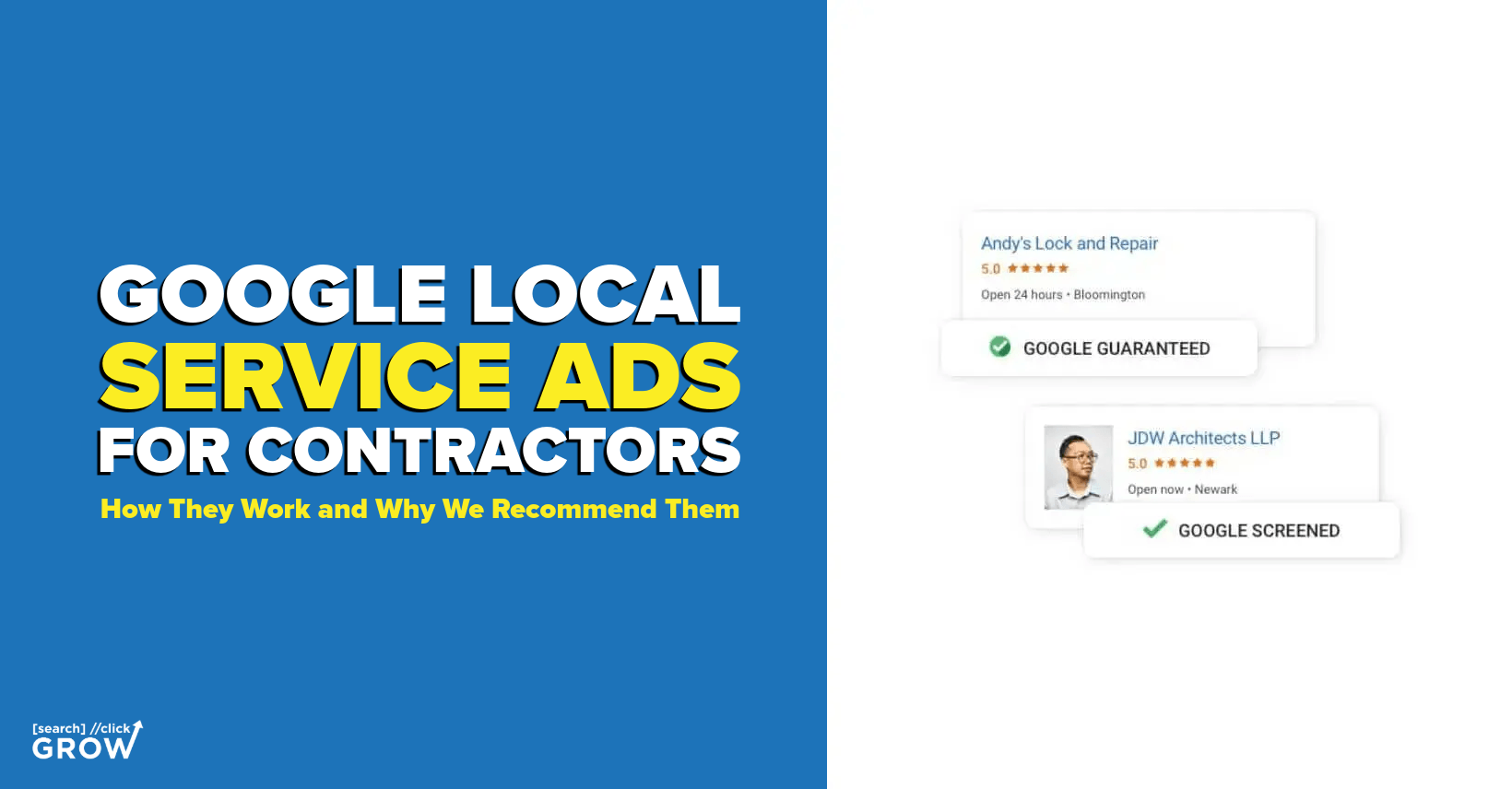
Those listings have a business name, a star rating, a review count, and a phone number. They also have a green badge that says “Google Guaranteed.” That badge is the difference between this ad format and everything else on the page.
Google Local Services Ads are the most visible paid placement available to home service contractors, and they’re structured completely differently from traditional Google Ads. You don’t pay per click. You pay per lead. You don’t manage keywords. Google matches you to relevant searches based on your job types and service area.
We recommend LSAs as the primary paid channel for most of the contractors we work with — not because they’re the only option, but because they’re the highest-intent, highest-trust placement available at a cost structure that makes sense for the trades.
This post explains exactly how they work, what the Google Guaranteed verification requires, what leads cost, and how LSAs fit alongside your other marketing channels
What Google Local Services Ads Are
Google Local Services Ads are a pay-per-lead ad format designed specifically for local service businesses. They appear at the very top of search results — above standard Google Ads, above the map pack, above everything else.
What makes them distinct from other Google ad formats:
- You pay per lead, not per click. If someone calls from your LSA listing, you’re charged. If they see the ad and don’t call, you pay nothing.
- Leads come as phone calls or messages directly through the Google platform. You receive a notification and can respond from the LSA app or your phone.
- You can dispute leads that aren’t relevant — a call from someone outside your service area, or for a service you don’t offer — and receive a credit.
- Your profile shows your business name, average star rating, review count, years in business, and the Google Guaranteed or Google Screened badge.
That last point matters more than most contractors realize. The Google Guaranteed badge isn’t decorative — it means Google has verified your business through a background check, license verification, and insurance confirmation. For a homeowner comparing options, that badge is a meaningful trust signal that most other ad formats can’t replicate.
Google Guaranteed vs. Google Screened
LSAs use two different trust badges depending on the type of business:
- Google Guaranteed — for home service businesses (contractors, plumbers, electricians, landscapers, painters, etc.). Google backs these businesses with a money-back guarantee for customers who are dissatisfied with the quality of work. The guarantee is up to a lifetime cap set by Google.
- Google Screened — for professional service businesses (lawyers, financial planners, etc.). No money-back guarantee, but still requires background and license verification.
If you’re a home service contractor, you’re pursuing the Google Guaranteed badge. The verification process is what separates LSAs from standard ads — it requires real documentation, and it takes time to complete, but it’s also what makes the badge meaningful.
How to Get Verified for Google Local Services Ads
Getting approved for LSAs requires completing Google’s screening process before your ads can run. The requirements vary slightly by trade and state, but for most home service contractors the process covers:
- Business license — provide your current contractor’s license for your state or jurisdiction
- Proof of insurance — general liability insurance is required; specific minimums vary by category
- Background check — Google runs a background check on business owners and any employees who enter customer homes
- Business information — your legal business name, address, phone number, and service area
The screening process typically takes one to two weeks, sometimes longer depending on your trade category and location. Start it early — you can’t run ads until verification is complete, and the process can stall if documentation isn’t submitted correctly.
Once approved, your listing is live and Google starts matching you to relevant searches in your service area.
How LSA Bidding and Lead Costs Work
Unlike traditional Google Ads where you set keyword bids, LSAs use a simpler model: you set a weekly budget and Google manages lead delivery within that budget.
Lead costs vary significantly by trade, location, and competition. Painting leads in a mid-size market might cost $15 to $40 per verified call. In a highly competitive urban market with multiple well-reviewed competitors, the same lead could cost $50 to $80 or more. Trades with higher average job values — like roofing or HVAC — tend to have higher lead costs because the economics support it.
The important thing to understand is that you’re paying for a phone call from someone who searched for a contractor in your area, saw your verified profile with your real review rating, and chose to call you. That’s a different quality of lead than a click on a display ad or a form submission from a shared lead platform.
You can set a target cost per lead and Google will optimize toward it. You can also pause your ads during slow periods, cap your weekly budget, and adjust your service area — you’re not locked into a fixed commitment.
Disputing irrelevant leads: Not every lead that comes through LSAs will be relevant. Google allows you to dispute leads that come from outside your set service area, are for a service type you don’t offer, are spam or wrong numbers, or are duplicate calls from the same person. Dispute within 30 days of the lead. Google reviews disputes and credits your account for approved ones. This is one of the most underused features — most contractors don’t know they can do this.
LSAs vs. Google Search Ads — What’s the Difference
Both are Google ad products. They serve different purposes and perform differently for contractors. Here’s how they compare:
| Google Local Services Ads | Google Search Ads | |
|---|---|---|
| Position on page | Above everything — ads, map pack, organic | Below LSAs, above organic |
| Cost model | Pay per lead (phone call or message) | Pay per click |
| Verification required | Yes — background check, license, insurance | No |
| Trust badge | Google Guaranteed or Google Screened | No badge |
| Setup complexity | Moderate — verification takes time | Higher — keyword and bid management ongoing |
| Best for | High-intent local leads, phone calls | Broader reach, specific keywords, landing page traffic |
| Control | Less keyword control — Google matches by job type | Full keyword, bid, and ad copy control |
Most contractors who are running paid ads should eventually run both — but if you’re starting from zero, LSAs are the right first step. Lower barrier to entry, simpler management, highest-trust placement, and a cost model that’s easier to evaluate on a per-lead basis.
Once your LSA profile is verified, active, and generating leads consistently, adding Google Search Ads gives you more control over keyword targeting, landing page traffic, and broader coverage for searches that LSAs don’t capture.
What Makes an LSA Profile Convert
Getting into LSA placement is just the start. Contractors with verified LSA profiles still vary widely in performance. The difference comes down to a few profile factors:
Review Count and Rating
LSA profiles show your star rating and review count prominently. A profile with 12 reviews at 4.6 stars will get fewer calls than a profile with 80 reviews at 4.9, even in the same position. Building your Google review count isn’t just a local SEO play — it directly affects LSA conversion.
Response Rate and Speed
Google tracks how quickly you respond to leads and displays your typical response time on your profile. A slow response rate damages your performance score and reduces how often Google shows your profile.
This connects directly to the broader truth about contractor lead conversion: the business that answers first wins. Research shows that 78 percent of customers hire the first business that responds to them. In the context of LSAs — where a homeowner is calling two or three contractors from the same search results page — answering immediately is the single most important thing you can do with the lead.
Service Area Accuracy
Set your service area to match where you actually work. Over-expanding to maximize impressions will dilute your performance data and generate more disputes. Strong engagement signals reward your LSA profile in Google’s algorithm — answer your calls, reply to messages, and turn leads into booked jobs.
Accurate Job Types
Select only the job types you actually perform. Getting matched to searches for services you don’t offer generates leads you’ll dispute and hurts your profile’s performance metrics over time.
Why We Recommend LSAs as the Primary Paid Channel for Contractors
We work exclusively with home service contractors, and across that work we’ve seen most paid channel combinations tried. LSAs have earned their place as the recommended starting point for a specific reason: the verification badge changes the conversion dynamic.
Every other paid placement — standard Google Ads, Facebook Ads, Angi, HomeAdvisor — puts your listing in front of a homeowner as just another option. LSAs put your listing in front of a homeowner with a Google endorsement attached. That’s not a small difference for a trade where trust is the primary buying factor.
The pay-per-lead model also makes ROI clearer to evaluate than pay-per-click. You know what you paid for each call. You know how many of those calls turned into booked jobs. You can calculate your cost per acquisition directly without attribution modeling or click-to-conversion tracking.
That doesn’t mean LSAs are the only channel worth running — they’re not. Combined with a fully optimized Google Business Profile, active local SEO, and eventually Google Search Ads, they’re part of a complete system. But as a starting point for a contractor who wants to generate high-quality inbound leads from Google, they’re where we start.
Getting Started With Google Local Services Ads
The process has four steps:
- Sign up at ads.google.com/local-services-ads and create your LSA profile
- Complete the verification process — license, insurance, and background check
- Set your service area, job types, and weekly budget
- Once approved, go live and monitor your lead inbox daily
Budget recommendation for contractors starting out: begin with a weekly budget equivalent to one to two leads at your estimated lead cost and increase as you validate the ROI. There’s no minimum spend requirement, but underfunding your budget in a competitive market will limit your impression share.
If you want help setting up and optimizing your LSA account — or want to understand how it fits into a broader paid and organic strategy for your contracting business — that’s exactly what we work through with contractors inside our coaching program. Learn more about working with SCG.