The Contractor’s Lead Generation Funnel: What Happens After the Lead Comes In

Most contractors think lead generation ends when the lead comes in. Phone rings, form fills, message pings — pipeline updated, next ad spend planned. That’s where the thinking stops.
That’s also where most contractor revenue leaks out.
The ad generated the lead. The lead sat for three hours before anyone called back. By the time you reached out, the homeowner had already hired your competitor who called them in two minutes. That’s not a lead generation problem — you generated the lead. That’s a lead conversion problem, and it’s a much bigger and more expensive one.
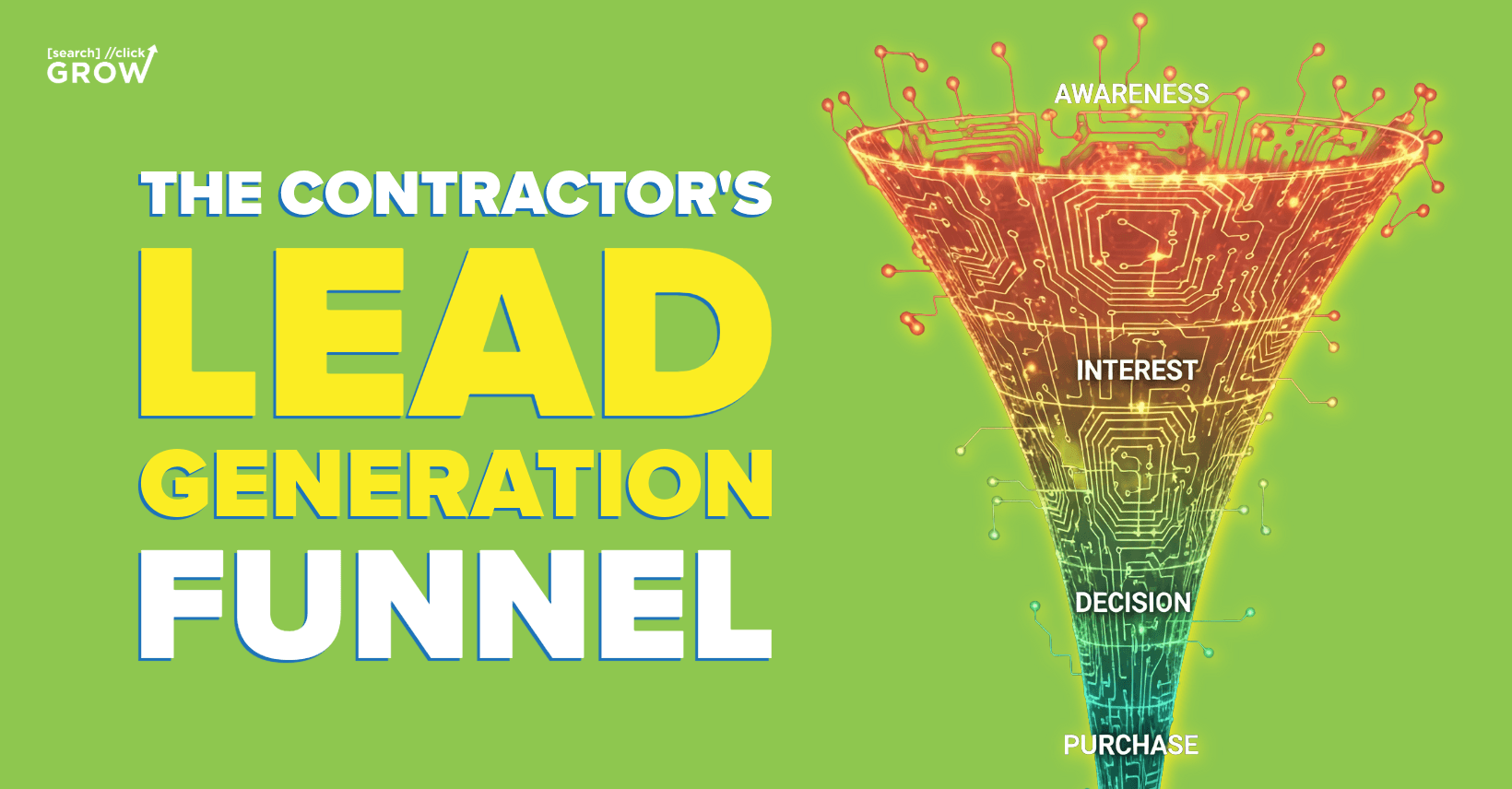
A lead generation funnel is one layer inside your broader marketing funnel — specifically the system that turns an inquiry into a booked sales appointment, and eventually a signed job. For contractors, that system has five core pieces — and when any one of them is weak, the whole system underperforms.
This post breaks down the full lead generation funnel for home service contractors: the pieces that matter, why each one drives conversion, and how they work together. If you’ve been generating leads but your pipeline still feels inconsistent, the gap is almost certainly somewhere in here.
Lead Generation vs. Lead Conversion — The Distinction That Matters
When most contractors say ‘I need more leads,’ what they usually mean is ‘I need more booked jobs.’ Those two things are related but not the same.
Lead generation is the activity of producing inquiries — Google Ads, SEO, referrals, Google Business Profile, Local Services Ads. All the channels that put strangers in touch with your business for the first time.
Lead conversion is what happens next — the sequence of touches, automations, and human interactions that turn that inquiry into an actual sales appointment, and eventually a closed job.
Most contractors are running hard on lead generation and underinvesting in lead conversion. The result is a leaky funnel — you’re paying for leads, but a significant percentage of them disappear before they ever turn into revenue.
A proper lead generation funnel includes both halves. You need the leads coming in, and you need the system to turn them into jobs. Missing either half breaks the math.
The Math That Explains Everything
Contractor A: 40 leads/month, 20% become appointments, 40% close = 3.2 jobs/month
Contractor B: 40 leads/month, 50% become appointments, 40% close = 8 jobs/month
Same ad spend. Same close rate on appointments. Same leads coming in.
2.5x more jobs — because Contractor B’s lead conversion system is better.
This is where most contractor revenue gets left on the table.
The 5 Pillars of a Contractor Lead Generation Funnel
Here’s the full system. Five pillars, each solving a specific problem in turning leads into booked jobs:
The 5 Pillars of a Contractor Lead Generation Funnel
Here’s the full system. Five pillars, each solving a specific problem in turning leads into booked jobs:
| Pillar | Purpose | Core Components |
|---|---|---|
| 1. Speed to Lead | Beat competitors to the first response | Live answering, missed-call text-back, CRM alerts |
| 2. CRM & Automation | Keep every lead visible and followed up | Centralized CRM, auto-replies, nurture sequences |
| 3. Booking & Reminders | Get the appointment and make sure they show | Online scheduling, confirmation texts, reminder calls |
| 4. Human Follow-Up | Close the gap automation alone can’t | Scheduled call attempts, voicemails, text check-ins |
| 5. Tracking | Measure what’s working and what’s leaking | Call tracking, source attribution, conversion reporting |
Pillar 1 — Speed to Lead
This is the single most underrated lever in contractor marketing. Speed to lead is the time between when a lead first reaches out to you and when you first respond.
Research consistently shows that 78 percent of customers hire the first business that responds to them — not the cheapest, not the best-reviewed, the first. And the drop-off after five minutes is dramatic: a lead contacted within five minutes is 21 times more likely to become a customer than one contacted after 30 minutes.
Most contractors are not responding in five minutes. They’re responding in hours — or sometimes days. Meanwhile, a faster-responding competitor is taking the same lead your ads just paid for.
The fix is a set of systems that ensure no lead sits uncontacted:
- Answer every phone call during business hours — a live human picking up is the highest-converting first impression possible
- Missed-call text-back automation — the moment a call goes unanswered, the caller gets an automatic text saying ‘Thanks for calling, we’re in the field — we’ll call you right back’ and keeping them engaged
- Form-fill automation — the second someone submits a web form, they receive an auto-reply confirming receipt and setting expectations for when they’ll hear back
- Internal alerting — your sales rep or office manager gets a push notification the instant a lead comes in, not a daily email digest
Speed to lead isn’t a software purchase — it’s a discipline built into how your team operates. The software just makes the discipline easier to sustain.
Pillar 2 — CRM and Automation
A CRM is the backbone of every other piece of the funnel. It’s the system that holds every lead, tracks every touch, and triggers the automations that keep leads from falling through the cracks.
What the CRM has to do for a contractor:
- Capture every lead from every source — web form, phone call, LSA, Meta lead form, referral — in one place
- Send automated first-touch replies so leads get a response in seconds, not hours
- Run nurture sequences for leads who don’t book immediately — a series of emails and texts that stay in touch across days and weeks
- Track every touchpoint so your team can see the full history when they follow up
- Trigger reminders for the human follow-up that automation alone can’t do
The specific CRM doesn’t matter as much as having one. HubSpot, GoHighLevel, JobNimbus, Service Fusion, HouseCallPro — plenty of tools can do the job. What matters is that every lead lives in one system and that system is actually used, not abandoned after setup.
The most common contractor CRM mistake: buying the software, doing a rushed setup, and then reverting to spreadsheets and sticky notes because the setup was never completed. The same principle applies to your Google reviews — a system that only captures some of your happy customers compounds slower than one that asks every time.
Pillar 3 — Booking and Appointment Reminders
Getting a lead to agree to a conversation is progress. Getting them to actually show up is conversion. Between those two points, contractors lose more deals than they should — and it’s almost always avoidable.
The pieces that make a booking system work:
- Online scheduling — let leads book themselves onto your calendar without a back-and-forth phone tag that often ends in them losing interest
- Immediate confirmation — the moment a booking is made, send a confirmation text and email with the date, time, address, and any prep they need to do
- Reminder sequence — automated reminders at 24 hours and 1 hour before the appointment, via text, dramatically reduce no-show rates
- Easy rescheduling — make it effortless to move the appointment; a reschedule keeps the lead in your pipeline, a no-show with no communication usually loses them
The math here is simple. If 20 percent of your booked appointments don’t show up, that’s 20 percent of your pipeline evaporating for no reason other than weak reminder systems. Getting that number from 20 percent to 5 percent with a simple reminder sequence is often the highest-ROI hour of work a contractor can do.
Pillar 4 — Human Follow-Up
This is the pillar that most contractors skip because automation makes them think it’s handled. It isn’t.
Some leads need a human. The lead that was busy when you called the first time. The lead who said they were interested but never booked. The lead who ghosted after the estimate. Automation can keep these leads warm, but it can’t close them.
A strong human follow-up process for contractors:
- Multiple call attempts at different times of day — if the first call goes to voicemail, try again at a different time rather than assuming they’re not interested
- Voicemails that matter — a brief, personal message that names them, references their specific inquiry, and ends with a clear next step
- Text follow-up between call attempts — text is often read when calls aren’t answered; short, human messages (‘Hey Sarah, wanted to make sure you got my voicemail — happy to answer any questions about the estimate’) re-engage leads who went cold
- A defined cadence — know how many touches over how many days before a lead is considered closed-lost; most contractors give up too early
Industry research consistently shows that 80 percent of sales require five or more follow-up attempts — and most sales teams stop after one or two. In contracting, where a single closed job is often worth thousands of dollars, the cost of giving up too early is enormous.
Pillar 5 — Call Tracking and Attribution
You can’t improve what you can’t measure. Call tracking and attribution are the systems that tell you which channels, campaigns, and ads are actually producing revenue — not just leads.
The basics:
- Call tracking numbers — assign different phone numbers to different marketing sources (Google Ads, LSAs, GBP, Meta, direct mail) so you can see which source each call came from
- Form source tracking — same idea for web form submissions; capture the source of every lead automatically in your CRM
- Conversion reporting — track not just leads but booked appointments and closed jobs back to their original source so you know what actually drove revenue
- Regular reporting review — look at the data weekly or monthly, and reallocate budget toward what’s actually working
Without tracking, you’re making budget decisions on intuition. With tracking, you can confidently double down on the channels producing real revenue and cut the ones that aren’t — which usually produces a larger performance improvement than any single campaign optimization.
How the Pillars Work Together
The pillars are interconnected — and the whole system is only as strong as the weakest pillar. A few examples of how they interact:
Speed to lead doesn’t work without the CRM and automation infrastructure to enable it. Human follow-up doesn’t work without a CRM telling you who needs a follow-up call today. Booking and reminders don’t work without a CRM holding the appointment data and triggering the reminder sequence.
The good news is that most of these pieces come together inside a single well-configured CRM. You don’t need five separate software tools. You need one tool, set up properly, with the workflows that cover all five pillars.
Where to Start If You’re Building This From Scratch
If your current lead conversion system is mostly ‘the phone rings and someone answers when they can,’ here’s the priority order I recommend:
First, fix speed to lead. This is usually the biggest single improvement you can make. Set up missed-call text-back today. Set up form auto-replies today. Configure your phones and team so calls are answered live during business hours. This alone will recover more leads than almost anything else.
Second, get every lead into a CRM. Not just the ones you remember. Every single inquiry from every source. If a lead isn’t in the CRM, it doesn’t get followed up, which means your ad spend on that lead was wasted.
Third, build the nurture and reminder automations. A simple 3-5 touch nurture sequence for leads who don’t book immediately, plus a reminder sequence for booked appointments. These are not complicated to set up — they’re just rarely set up at all.
Fourth, define your human follow-up cadence. How many call attempts. Over how many days. Who’s responsible. Track whether it’s actually being done.
Fifth, add call tracking and attribution. Once the conversion system is working, understanding which channels drive it lets you scale what’s working.
You don’t have to build all five pillars in a week. You have to build them all, eventually, in the right order, before your lead generation efforts produce the returns they should.
Why This Matters More Than More Leads
Most contractors, when revenue feels tight, default to the same solution: ‘we need more leads.’ More ad spend. More campaigns. Bigger budget.
Sometimes that’s the right answer. Often it isn’t.
If your lead conversion system is leaking — slow response times, no CRM, poor follow-up, no reminder system — adding more leads just scales the leak. You’ll pay twice as much for ads and end up with a proportional increase in jobs, which means your cost per job goes up instead of down.
Fixing the lead generation funnel first — the conversion pillars — often produces more revenue at lower spend. Same ad budget, better conversion rates, more booked jobs, higher ROI on every marketing dollar you spend from that point forward.
This is the real growth unlock. Not more leads. A better funnel that turns the leads you already generate into the revenue those leads should produce.
The Work That Compounds
Every one of the five pillars compounds once it’s built. A CRM set up today is still working for you three years from now. A nurture sequence written once runs forever. A reminder automation installed this week reduces no-shows on every future appointment. Speed-to-lead discipline trained into your team becomes part of how they operate permanently.
Unlike ad spend, which produces results only in the moment it runs, lead conversion infrastructure is a one-time build that keeps returning dividends on every future lead. That’s why the contractors who scale durably invest here first.
If you want help building out the full lead generation funnel — from the right CRM stack for your business to the specific automations and sequences that match your trade — book a call to talk through where your funnel stands today.